Great Depression & World War II
"Big Train" Duplicates Washington's Coin Toss
"Big Train" Duplicates Washington's Coin Toss
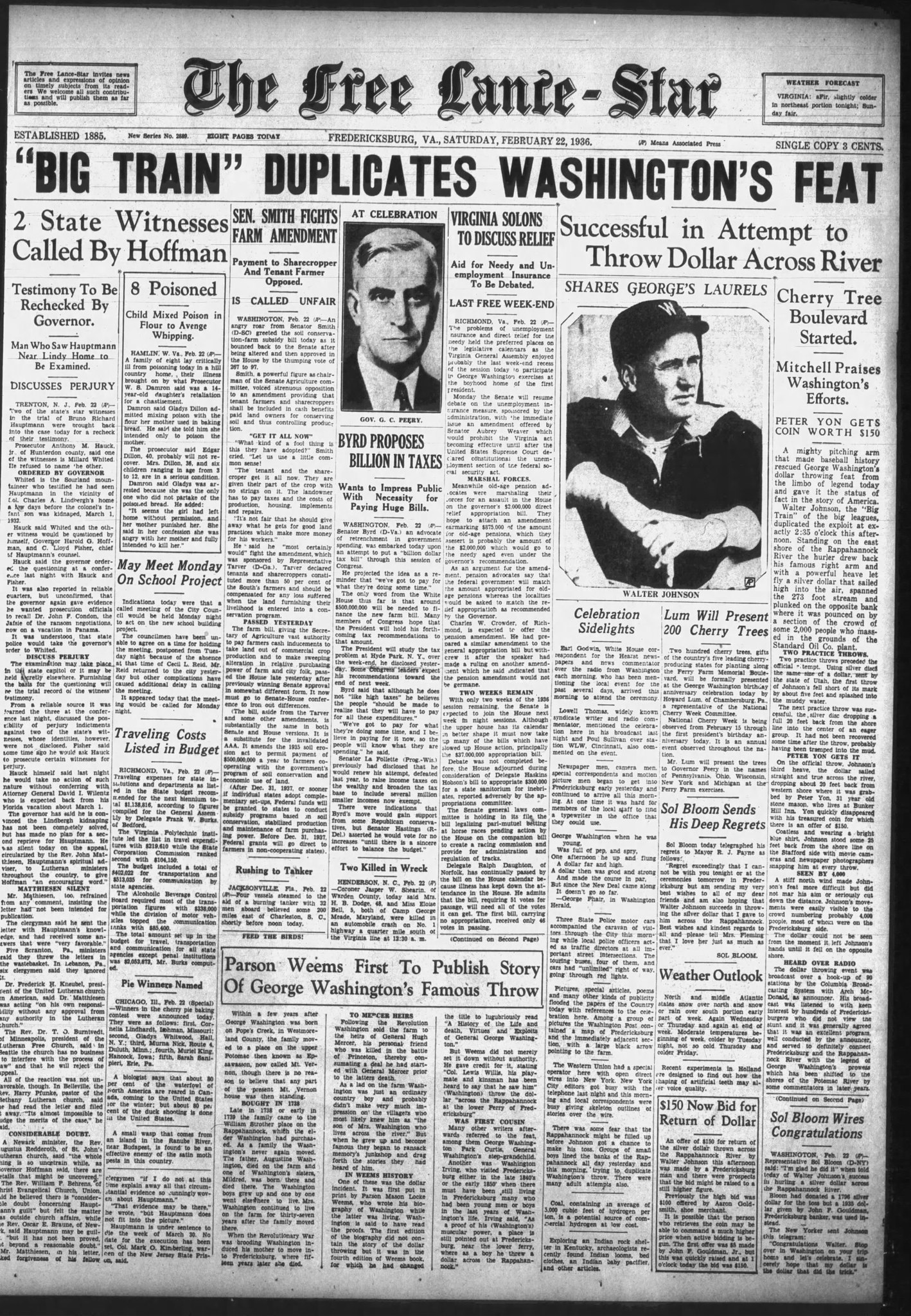
National attention briefly focused on Fredericksburg 90 years ago today, February 22, 1936, a Saturday, as the community marked George Washington’s 204th birthday with grand gestures and spectacle. Dignitaries arrived to dedicate the Cherry Tree Memorial Boulevard, a stretch of King’s Highway to be lined with cherry trees between Chatham Bridge and Washington’s boyhood home at Ferry Farm, then in private hands. Media interest, however, centered on the attempt by baseball legend Walter Johnson to duplicate the first president’s childhood feat of tossing a coin across the Rappahannock.
The event likely would never have happened at all if Alexandria had scheduled a major Washington celebration that day. When Fredericksburg’s Chamber of Commerce learned the city to the north was passing on marking the occasion, the group hurried their plans for the boulevard dedication, which was intended to be the main event. With scarcely five weeks to spare, invitations went out to President Roosevelt (who declined) and Governor George C. Peery and the Virginia General Assembly (who accepted).
The Japanese ambassador donated 200 flowering cherry trees, while governors of five cherry-growing states offered fruit-bearing trees to alternate with the Japanese trees to fill out the boulevard landscaping. The Virginia Department of Highways directed the work as a WPA project, as workers began to prepare for the tree planting. Winter weather, however, delayed the preparatory work, and with the trees not ready for planting until fall, a symbolic planting ceremony would have to suffice for the 22nd.
At this point, spectacle took over. With just six days before the event, newspapers announced that Walter Johnson, the former Washington Senators pitcher who had just become one of the first five inductees into the Baseball Hall of Fame, would attempt to throw a silver dollar across the Rappahannock, emulating Washington’s legendary achievement. A media frenzy ensued.
Rep. Sol Bloom of New York, erstwhile director of the George Washington Bicentennial Commission, pounced immediately. Believing the myths surrounding Washington to be a disservice to history, Bloom offered to bet 20 to 1 that Johnson wouldn’t land a coin on the opposite side of the river. The Free Lance-Star accepted the terms. So did others, with Benjamin Pitts, Chamber of Commerce president, depositing a check for $5,000 at Farmers & Merchants State Bank and insisting that the congressman put up $100,000 “or shut up” about the Washington legend. Then Bloom appeared to hedge, even as offers came in from across the nation to cover his end of the bet.
Bloom now asserted that the Rappahannock was much wider in Washington’s day and that any throw would need to cover that distance, which he estimated at around 1,500 feet, rather than the approximate 375-foot width in 1936. (The river had indeed been wider before the Army Corps of Engineers dredged it and deposited the sediment as fill on the Ferry Farm side, but it wasn’t over 1,000 feet wider.) With neither side backing down on the distance for the throw, the bet was called off by the appointed day.
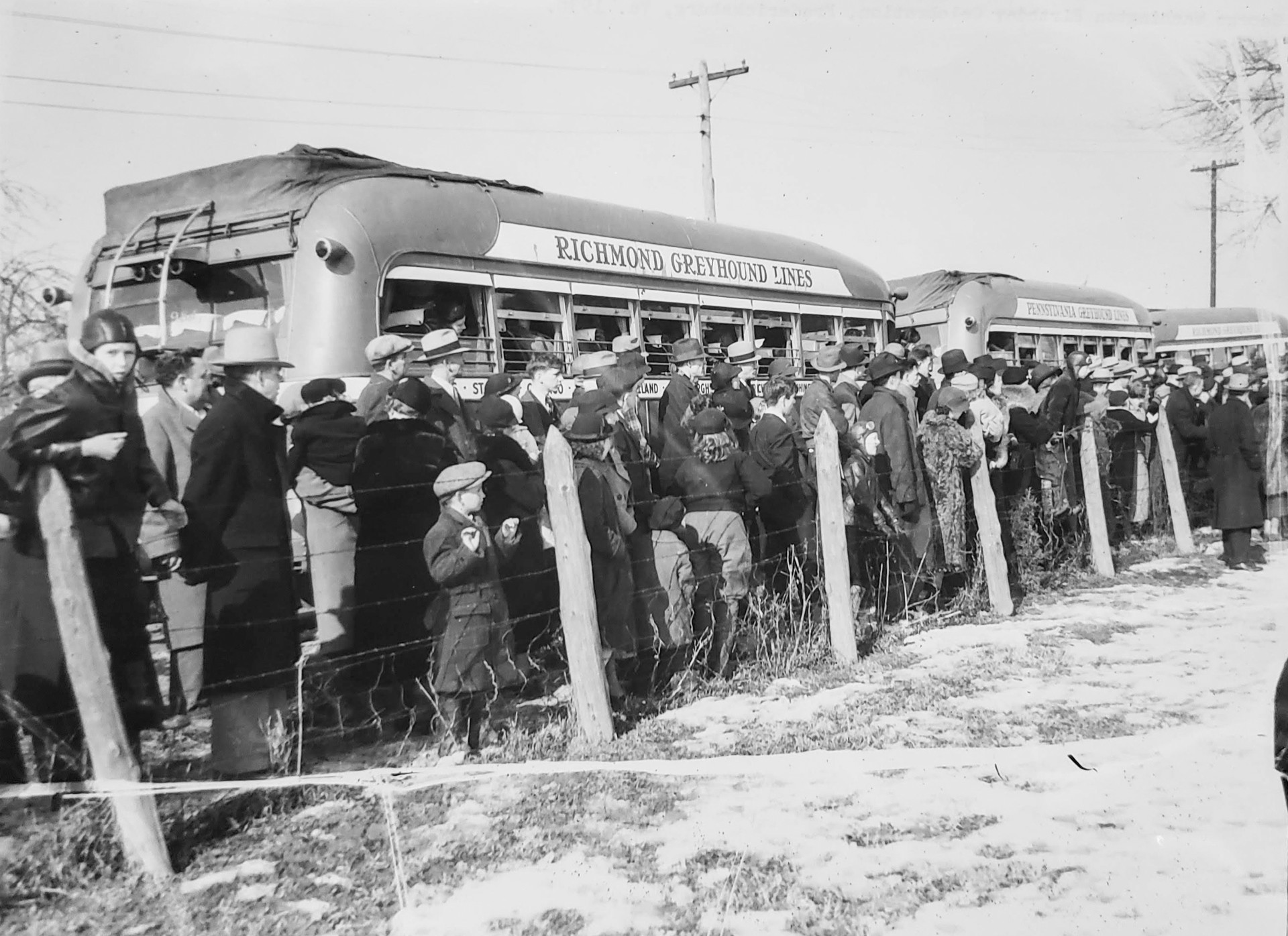
Late on Friday afternoon, February 21, dignitaries from Richmond began to pour into town in Greyhound buses and private cars, bound for the State Teachers College, where dinner, entertainment, and accommodations awaited them. The morning of the 22nd, a wreath-laying at the Mary Washington Monument and a tour of the city’s historical attractions led off the day’s events. After a luncheon at the Stratford Hotel, the entourage headed to Ferry Farm for the boulevard dedication ceremony and Walter Johnson’s throw, set for 2:30 – 2:40 to meet the Columbia Broadcasting System’s radio schedule.
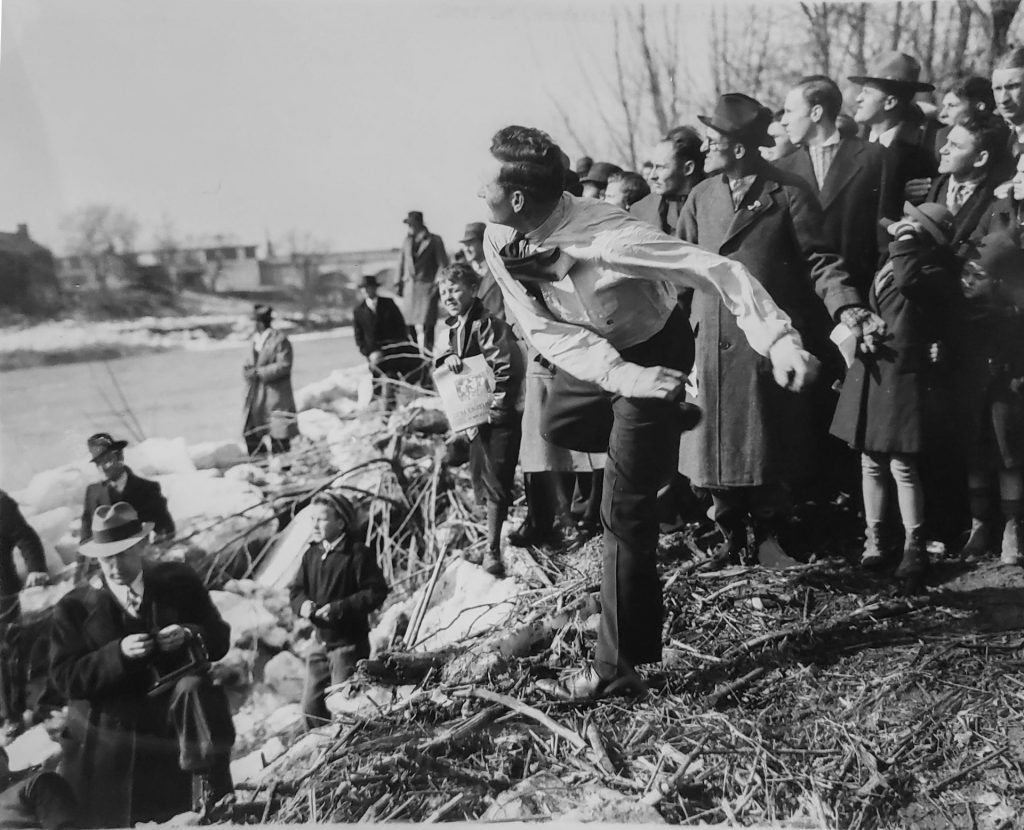
Spectators lined the banks of the Rappahannock on both sides. Standing in shirtsleeves on the ice-strewn east bank, Johnson made two practice throws with silver discs, with reporters and cameramen recording every move. The first throw landed in the water a few feet short of the farther shore. The second landed about 20 feet beyond the opposite river bank. Then came the official throw with a silver dollar inscribed for the event. The third and final throw sailed across the river, landing at the feet of Peter Yon, an Italian mason who worked at Fredericksburg and Spotsylvania National Military Park building the park’s bridges and culverts. Although eligible for a reward for retrieving the coin, Yon held on to his souvenir, awaiting higher offers. (He apparently never collected.)
After Johnson’s successful throw, the crowds largely dispersed, leaving only about 200 to stay for the featured event, the dedication of the memorial boulevard and a symbolic tree planting.
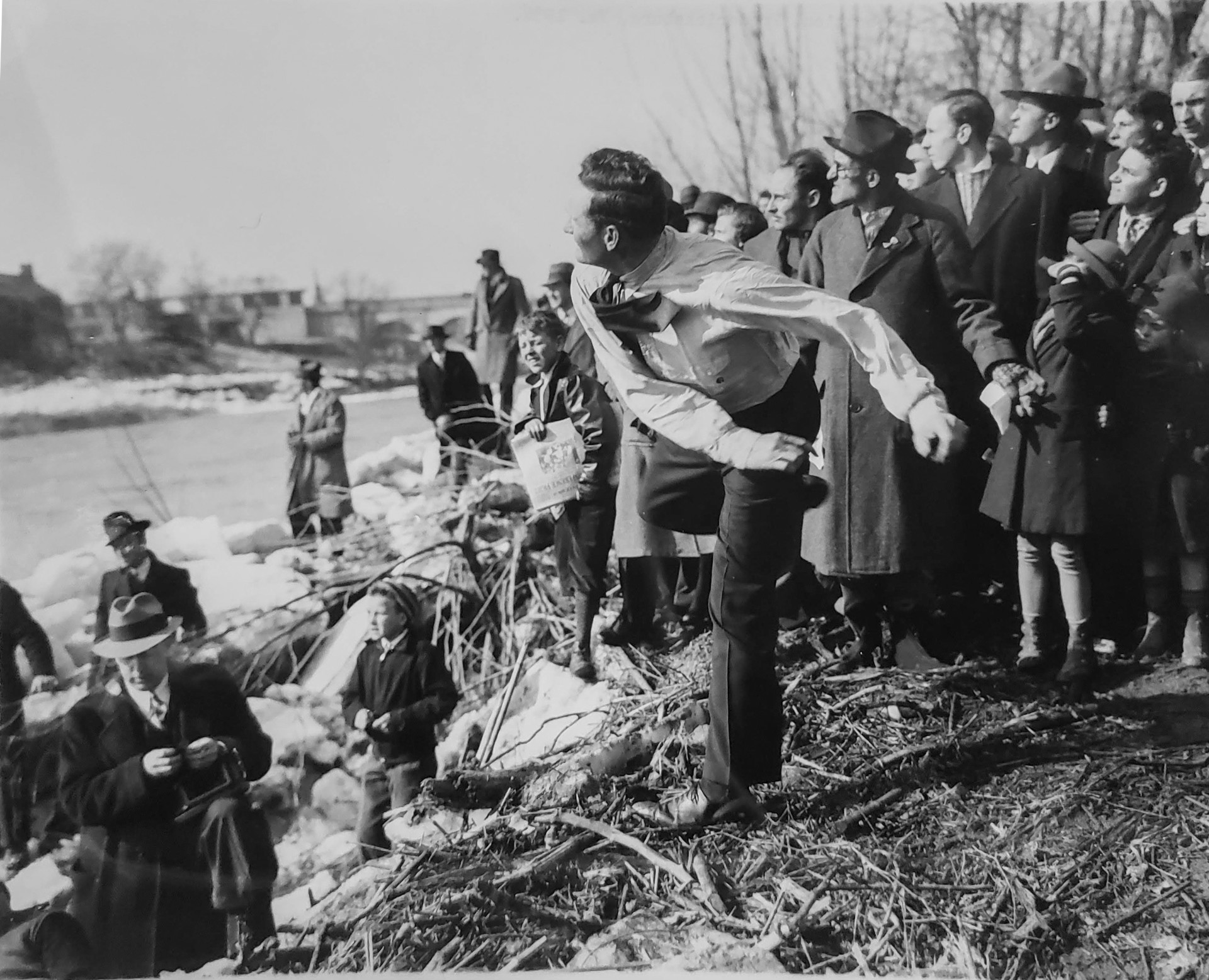 Baseball great Walter Johnson is shown mid-throw with onlookers on the banks of the Rappahannock opposite Fredericksburg. The photo is from the Virginia Chamber of Commerce Photograph Collection at the Library of Virginia.